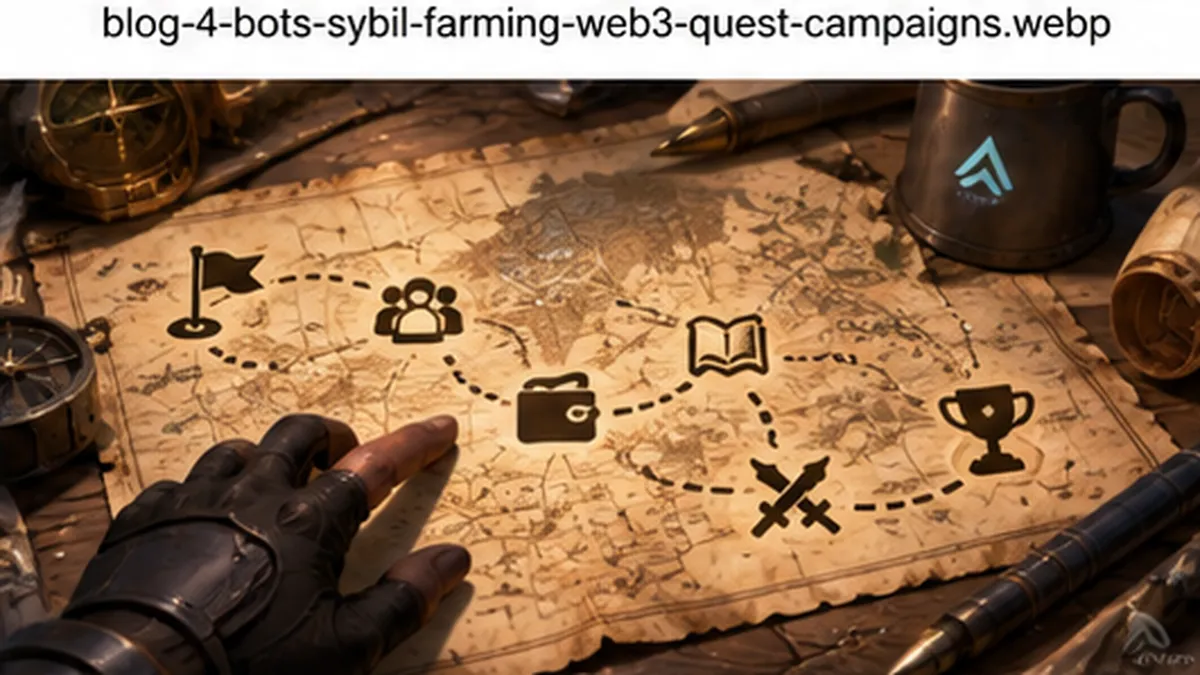
A Web3 quest campaign should begin with a behaviour you want to create — not a list of tasks you want people to complete.
Before choosing rewards, XP or social actions, define what success actually looks like.
Then build a journey that moves participants toward it.
Here is a practical framework.
1. Define the campaign objective
Start with one primary outcome.
For example:
- introduce users to a new ecosystem;
- activate wallets;
- teach users how a product works;
- increase usage of a specific feature;
- introduce an on-chain action;
- encourage existing users to return;
- move users across several ecosystem applications.
Avoid starting with:
“We need 10 quests.”
The number of tasks is not the strategy.
2. Define the meaningful action
What behaviour would demonstrate that the campaign has moved beyond awareness?
This might be:
- successfully using a protocol;
- bridging;
- making an eligible transaction;
- minting;
- staking;
- interacting with a particular smart contract;
- completing multiple product actions.
This becomes the activation point around which the campaign can be structured.
3. Reduce friction before activation
Do not assume every participant already understands the ecosystem.
Early quests can provide context.
Explain:
- what the product is;
- what the user will be doing;
- why the action matters;
- what they need before beginning.
Educational and social actions are particularly useful here when they prepare participants for the more meaningful activity that follows.
4. Decide what needs verification
Not every campaign action requires the same standard of proof. Choosing between social and on-chain quests helps match the verification method to the behaviour.
For each quest, establish what constitutes completion.
A social or educational interaction might use one verification method.
An on-chain action can potentially be checked against blockchain activity.
The important principle is that verification matches the significance of the task.
The more important an action is to the campaign objective, the more confidence the project should have that it genuinely occurred.
5. Turn tasks into progression
Now connect those individual actions together.
Instead of:
Task 1
Task 2
Task 3
Task 4
Think:
Discover → Learn → Activate → Explore → Master → Return
Each stage should make the next stage feel logical.
This is where campaigns begin to resemble playable journeys instead of marketing checklists.
6. Assign XP according to behavioural value
XP can signal which activities represent deeper participation.
Introductory activity might contribute modestly.
More meaningful verified interactions can contribute more.
Advanced stages can reward continued engagement.
Avoid making the system unnecessarily complicated.
A participant should be able to understand:
what they have achieved and how they progress.
7. Design against low-quality participation
Ask how someone could exploit the campaign while providing minimal value.
Could they complete everything without understanding the product?
Could the same simple action be repeated across many wallets?
Can someone reach the highest reward tier without meaningful engagement?
These questions often reveal weaknesses before launch, including exposure to bots and Sybil farming.
Campaign design should increase the value of genuine progression without introducing arbitrary friction for legitimate users.
8. Define measurement before launch
Decide what will be measured before campaign activity begins. A clear campaign measurement framework makes it easier to separate meaningful participation from vanity metrics.
At minimum, consider:
Reach → Entry → Activation → Verification → Progression → Completion → Return
Also separate:
- social actions;
- wallet activity;
- verified product activity;
- XP;
- repeat activity.
Without this structure, teams often finish campaigns with impressive totals but little understanding of what happened.
9. Build the next step
What happens when someone completes the campaign?
There should be somewhere for the relationship to continue.
This could be:
- another campaign chapter;
- another product feature;
- continued XP progression;
- a community experience;
- an ecosystem pathway;
- a later season.
Campaign completion should ideally feel like progression rather than termination. Planning for user retention after the quest helps make that continuation deliberate.
10. Analyse quality, not just quantity
After launch, avoid evaluating success from the biggest available number.
Instead, ask:
How many participants activated?
How many completed verified actions?
How deep did they progress?
Where was the largest drop-off?
Which participants returned?
Did high-progression users behave differently later?
Those answers help improve the next campaign.
A simple Web3 quest campaign framework
The complete process can be reduced to:
Objective
↓
Education
↓
Activation
↓
Verification
↓
Progression
↓
Deeper behaviour
↓
Retention
Everything inside the campaign should support one of those stages.
If a task does not contribute to the user journey or improve the project’s understanding of participants, ask whether it needs to exist at all.
From campaign activity to campaign intelligence
Web3 provides marketers with an unusual opportunity.
Campaign participation can potentially be connected with verifiable product behaviour rather than ending with clicks and impressions.
But that value only appears when the campaign is deliberately structured to reveal it.
Afyniti is designed around that principle: transforming Web3 campaigns into playable journeys where participants progress through missions, verified activity and XP while projects gain a clearer view of engagement.
The goal is not more quests.
It is better-designed participation.